DOC-2026-0217-CAPITOL // DISTRIBUTION: LIMITED
ACCESS CLOSES BEFORE NEXT TRADE ALERT:
Tuesday, February 24th at 2:00 PM EST
"Is This Legal?!?"
The Defense Insider Who Called Red Cat's 5,400% Move Just Found His Next Target
When Frank Gregory's members banked that trade in six days, some of them emailed asking the same question:
How is this legal?
When you're consistently finding stocks that explode 50-100% within 24-72 hours, before the news even breaks, it looks suspicious.
But Frank isn't trading on insider information. He's not hacking Pentagon servers.
He's reading the 200-page procurement documents that Wall Street analysts skim. Or ignore entirely.
These are public records. Congressional committee reports. Contract awards buried in government databases. The kind of dense, jargon-heavy paperwork that most traders will never touch.
Frank spent 12 years in defense contracting. He knows which contracts matter. He knows which companies are positioned to win. And he knows how to read the signals before they become headlines.
When Red Cat announced their 5,880-drone Pentagon deal, it wasn't a surprise to Frank.
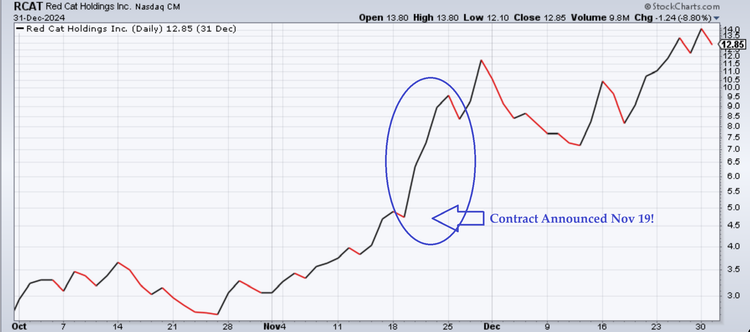
He'd been tracking that contract for weeks. By the time CNBC covered it, his members were already banking 5,400% gains.
If you were one of them, you could've turned $3,000 into $165,000.
10 WINS. 3 DAYS OR LESS. ALL IN 2025.
Red Cat wasn't a fluke. In 2025 alone, Frank's intelligence has led to 10 winning trades that opened and closed in three days or less:
Average gain: 76.8% in under 3 days
"Had 3k, sold 2500 @ 5.69 with 500 to run. What a win!"
"KTOS Calls at $3. Took a whole week to make 100%!"
"I held one USAR for a double"
These aren't buy-and-hold plays. These are fast, targeted strikes on stocks about to move. Based on verifiable government actions that Frank spots before the market catches on.
Is it legal? Every bit of it. Frank's just doing the homework Wall Street won't.
And right now, Frank is tracking the biggest opportunity since Red Cat.
Frank's next pick is a small-cap pure-play on portable nuclear. Andrew has the options setup ready. Access closes Tuesday.
Get Frank's Nuclear Pick for $4WHY FRANK SEES IT FIRST
Most "defense analysts" on Wall Street spent a summer interning on the Hill and now call themselves insiders.
Frank spent 12 years in the trenches. Defense contracting. Working directly with Pentagon officials, military procurement officers, and the contractors vying for their attention. He started as a Hill lawyer, then moved from K Street to Wall Street, straddling both worlds in a way almost nobody in finance does.
He still attends events like AUSA, one of the largest defense trade shows in the country, where the Secretary of the Army, high-ranking officers, and foreign dignitaries show up. He's got contacts on the Hill, relationships with company leadership, and connections to startup CEOs, military officials, and even Secret Service members.
This isn't LinkedIn networking. These are the people who know which programs are accelerating, which contracts are imminent, and where the money is actually flowing.
He was doing early banking work on USAR back in 2019, years before Wall Street figured out the stock existed. By the time analysts caught up, his members had already banked four separate winning trades on it.
But he doesn't work alone. By his side is Andrew Giovinazzi, a 30-year options trading veteran. Andrew can look at an options chain and structure the exact trade that maximizes profit while limiting risk.
Frank finds the stocks. Andrew structures the trades. Members get the alerts before Wall Street even knows there's a story.
That's how Capitol Gains works. And right now, Frank is watching something bigger.
THE PENTAGON IS FLYING NUCLEAR REACTORS
Two of the most powerful people in the U.S. national security apparatus just strapped themselves into a cargo jet. Next to a nuclear reactor.
The Energy Secretary. The Under Secretary of Defense for Acquisition. Both on a C-17 Globemaster III, flying a Ward 250 microreactor from March Air Reserve Base in California to Hill Air Force Base in Utah.
The Pentagon called it Operation Windlord. The first-ever airlift of a nuclear microreactor. And this wasn't some unmanned test flight.
That's not a press release. That's the U.S. government telling the world: this technology is real, it works, and we're deploying it.
Energy Secretary Chris Wright, from the plane: "The American nuclear renaissance is to get that ball moving again, fast, carefully, but with private capital, American innovation and determination."
Under Secretary Michael Duffey, same flight: "Powering next generation warfare will require us to move faster than our adversaries, to build a system that doesn't just equip our warfighters to fight, but equips them to win at extraordinary speed."
And here's what makes this bigger than one flight. Look at the timeline:
May 2025: Trump signs four executive orders on nuclear energy. The goal: quadruple U.S. nuclear capacity from 100 GW to 400 GW by 2050. Ten large reactors under construction by 2030.
Then the dominoes start falling. October: Pentagon launches the Janus Program for military microreactor deployment. November: Valar Atomics achieves zero-power criticality, the first nuclear startup in the DOE's pilot program to hit that milestone. December: DOE awards $800 million for small modular reactor deployment.
February 2026: Operation Windlord. First-ever nuclear reactor airlift. Two cabinet officials on board.
July 4, 2026: The target date for three pilot reactors achieving criticality on U.S. soil.
Each step escalates. Executive orders. Program launches. Funding. And now a live demonstration that the Pentagon called "directly aligned with President Trump's Executive Order to reshape and modernize America's nuclear energy landscape."
Three massive power demands are converging at once:
AI & Data Centers: Hyperscale AI facilities consume 100-1,000+ megawatts, equivalent to mid-size cities. Grid constraints are already slowing deployments.
Defense Resilience: The Pentagon said it plainly: a reactor "could provide energy security on a military base, ensuring the mission there need not depend on the civilian power grid." Forces overseas could operate "without concern that an enemy might cut fuel supplies."
Remote Industrial: Mining, Arctic drilling, island grids. All need reliable baseload power where the grid doesn't reach.
When DoD validates a technology like this, it accelerates permitting, unlocks private capital, and moves the entire sector from speculative to strategic. That's happening right now.
WARNING: DOD VALIDATION OF PORTABLE NUCLEAR IS ACCELERATING. JULY 4TH CRITICALITY DEADLINE APPROACHING. THE SECTOR IS MOVING FROM SPECULATIVE TO STRATEGIC.
SMALL-CAPS MOVE. BIG NUCLEAR DOESN'T.
BWX Technologies. NuScale Power. Cameco. Centrus Energy.
They're all in the nuclear and SMR space. They're all positioned for the portable power buildout.
But here's the thing about large-cap nuclear plays: a single DoD contract doesn't move the needle. Their stocks barely budge on individual awards.
The sector is already moving. Nuclear and SMR stocks are up double digits year-to-date on policy momentum alone. This isn't about one company. It's a sector-wide bid driven by everything on that timeline above.
Small-caps are a different story entirely.
Sidus Space got added to the SHIELD list. The stock jumped 97% in a single day. Up 218% in the past month just for being eligible to compete.
Kratos landed a $1.45 billion hypersonic contract in January. The stock ripped 190% over the year.
Look at the volatility in this space. One nuclear small-cap has a 52-week range of $17 to $60. The gap between the low and the high is 250%. That's what happens when a small company sits at the center of a sector the government is throwing billions at.
When a $500 million company gets DoD validation, it moves. When a $50 billion company gets the same thing, nobody notices.
Frank has identified a small-cap pure-play on portable nuclear. It's focused on transportable, off-grid microreactors. The exact application the Pentagon just validated with Operation Windlord.
Andrew has the options setup ready. The July 4th criticality deadline is approaching. The only question: will you be positioned before the market catches on, or chasing it after?
Get Frank's Nuclear Pick for $4ONE COMPANY. ZERO WALL STREET COVERAGE.
While analysts focus on the large SMR developers targeting utility-scale deployment, this company is doing something different.
It's building microreactors designed specifically for transportable, off-grid applications. The exact use case the Pentagon just demonstrated to the world.
It's not competing for the same contracts as NuScale or Oklo. It's operating in a niche that the military just showed the world it needs. And its market cap is small enough that a single contract or partnership announcement could send shares soaring.
Frank knows the name. Andrew has the trade setup. And access closes Tuesday.
Here's what you get the moment you join:
WHAT YOU GET THE MOMENT YOU JOIN

The Portable Nuclear Company Name + Full Analysis
Frank's pick, his research, and Andrew's recommended options setup. The ticker, the thesis, and the trade. All before Tuesday.
Trade Alerts as They Happen
When Frank and Andrew pull the trigger, you get the exact trade: ticker, strike, expiration, entry. No delays. No guessing.
Direct Line to Frank and Andrew
Questions about a position? They're in the private member chat daily. You're not submitting a support ticket. You're talking to the guys making the calls.
Weekly Video Briefings
What's moving in Washington. Which sectors are heating up. Where the next contract is landing. Straight from Frank and Andrew, every week.
The Full Trade Archive
Every entry, every exit, and the intelligence behind each one. Red Cat. NVDA. KTOS. The complete playbook.
THE OFFER
TRY CAPITOL GAINS FOR $4
Your first month is $4. Then $99/month. Cancel anytime.
Why $4?
Because Frank wants you to see how this works before you commit.
Get in. See the portable nuclear company. Watch what happens as DoD adoption accelerates and private capital follows. If you're not impressed, cancel before your second month. You're out $4.
But if Frank's right, if this company moves the way small-cap defense plays have when the Pentagon validates their sector, you'll understand why members stick around.
One winning trade pays for years of membership. Red Cat returned 5,400%. Members turned $3,000 into $165,000.
Join now and you're looking at Frank's portable nuclear pick within five minutes.
Cancel Anytime. No Questions.
Try it for $4. See the company. See the trade.
If you don't love it, cancel before month two.
You're risking $4 to see if Frank's edge is real.
Here's what happens if you wait:
The Pentagon announces its next microreactor contract. Or the July 4th criticality target gets moved up. The stock gaps up 40% at the open. Options that were $1.50 yesterday are $6 by 9:31 AM.
You're watching from the sidelines, calculating what you could have made. Reading about it on CNBC instead of banking the gains.
That's exactly what happened with Red Cat. The members who were positioned banked life-changing gains in six days. Everyone else watched.
The validation already happened. The catalysts are stacking up. The only question is which side you're on when the market catches up.
WHAT'S COMING BETWEEN NOW AND JULY 4TH
The Pentagon didn't build Operation Windlord as a one-off demonstration. It's the opening move in a deployment timeline that's accelerating.
Three pilot reactors are targeted to achieve criticality on U.S. soil by July 4th. Between now and then, every milestone along that path is a potential catalyst: Janus Program contract awards, DOE funding announcements, new executive actions, and the first operational microreactor on a military installation.
Any one of those could be the headline that sends a small-cap pure-play in this space vertical overnight. The same way Red Cat moved when the Pentagon validated drones. The same way Sidus moved 97% on eligibility alone.
The difference is whether you're positioned before those headlines hit, or reading about them after.
Access closes Tuesday at 2:00 PM EST, before Frank and Andrew release their next trade.
After you join, you'll have the company name, Frank's full analysis, and Andrew's options setup within minutes. When the next catalyst lands, you'll already be in.
P.S. Red Cat was a $340 million contract. Members made 5,400%, turning $3,000 into $165,000.
Portable nuclear is where AI, defense, and energy collide. Three demand drivers. One sector. And the Pentagon didn't just validate the technology, they flew a reactor across the country with two cabinet officials on board.
Frank's pick is a pure-play on transportable microreactors. Small cap. Volatile. And positioned at the center of everything.
July 4th is the target for three reactors achieving criticality on U.S. soil. Every catalyst between now and then is a potential trigger.
Try it for $4. Get the company name. Cancel anytime.
Is it legal? Once you see how Frank does it, you'll wonder why everyone isn't.
Access closes Tuesday. The next trade won't wait.